
Beaches in South Wales
The coastline of South Wales is home to over 100 beaches, many of which are award winning. You'll find all types of beaches in South Wales, from tiny rocky coves to miles of wide golden sand. Our guide will help you find the perfect beach for your trip.
Explore our award-winning coastline
From Seaside Awards to Blue Flag locations, South Wales is home to an incredible selection of award-winning beaches, making it one of the UK's best destinations for days out and holidays by the seaside. From traditional hotspots like Barry Island, to rocky coves including Nash Point, and wide expanses of golden sands such as Rhossili Bay, you'll find all types of beach here.
South Wales beaches at a glance
The South Wales coastline runs from the Severn Estuary in the east to Carmarthen Bay in the west, and it changes character completely along the way. In the east you have the wide muddy tides of the estuary. Through the Vale of Glamorgan the Heritage Coast throws up dramatic layered limestone cliffs above pebble and sand bays. Swansea Bay gives you a long sweeping curve of sand right on the edge of a city. The Gower Peninsula, the first place in Britain to be designated an Area of Outstanding Natural Beauty, packs some of the finest beaches in the country into nineteen miles. And out west toward Tenby and Pembrokeshire you get golden sand, harbour towns and island views.
In 2026, 48 sites across Wales received a Coast Award from Keep Wales Tidy, with Blue Flags flying at 20 locations, alongside 15 Seaside Awards and 13 Green Coast Awards. A significant share of those are on the South Wales coast.
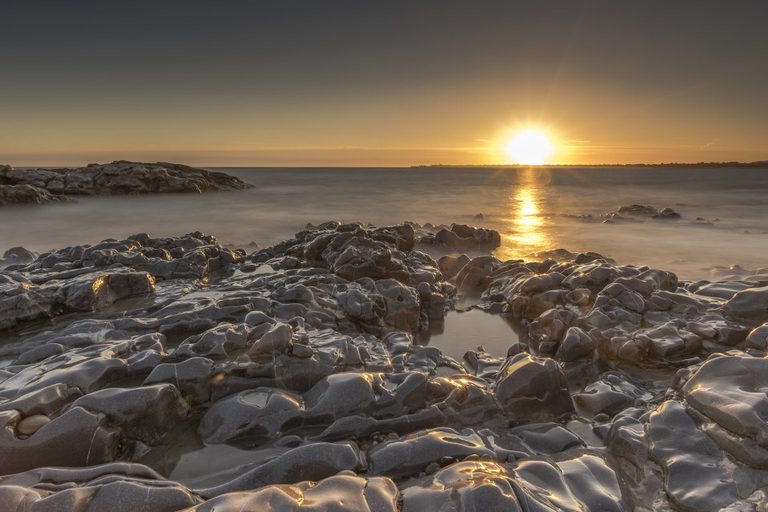
The best beaches in South Wales

Saundersfoot Beach in Pembrokeshire is a wide sandy beach beside a picturesque harbour village,… Saundersfoot Beach in Pembrokeshire is a wide sandy beach beside a picturesque harbour village, offering family friendly seaside views across Carmarthen Bay.

Dunraven Bay on the Glamorgan Heritage Coast is a scenic beach near Southerndown with limestone… Dunraven Bay on the Glamorgan Heritage Coast is a scenic beach near Southerndown with limestone cliffs, rock pools and coastal views across the Bristol Channel.
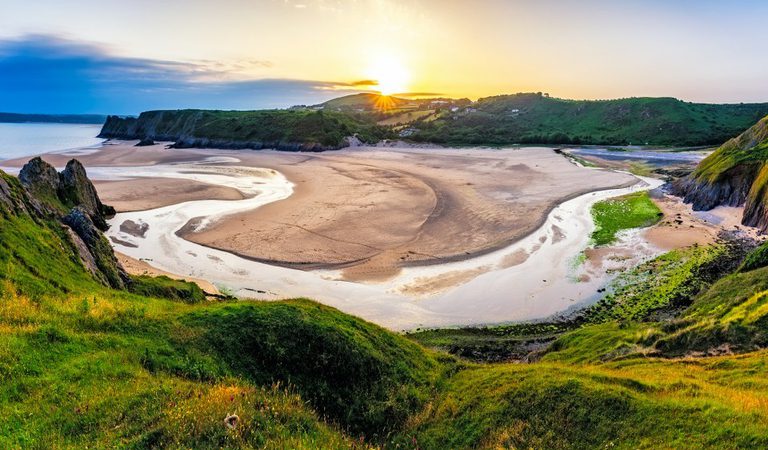
Three Cliffs Bay Beach on the Gower Peninsula is a scenic beach known for limestone cliffs, sandy… Three Cliffs Bay Beach on the Gower Peninsula is a scenic beach known for limestone cliffs, sandy shores and coastal walks in one of Wales’ most beautiful landscapes.

Langland Bay is a scenic Gower beach with sandy shores, colourful huts and coastal paths, popular… Langland Bay is a scenic Gower beach with sandy shores, colourful huts and coastal paths, popular for swimming, walking and relaxed seaside days.

Monknash Beach is a secluded Vale of Glamorgan beach with dramatic cliffs, rock pools and coastal… Monknash Beach is a secluded Vale of Glamorgan beach with dramatic cliffs, rock pools and coastal walks, perfect for peaceful exploring and enjoying unspoilt natural scenery.

Sandy Bay in Porthcawl is a sheltered, family-friendly beach near the harbour, offering calm… Sandy Bay in Porthcawl is a sheltered, family-friendly beach near the harbour, offering calm waters, sandy shores and easy access to shops, cafes and seaside attractions.

Penally Beach towards the end of Tenby South Beach is a dog-friendly sand & shingle beach backed by… Penally Beach towards the end of Tenby South Beach is a dog-friendly sand & shingle beach backed by dunes and countryside, offering wide views across Carmarthen Bay and a…

Monkstone Beach is a secluded dog-friendly beach near Tenby, reached by a steep path and loved for… Monkstone Beach is a secluded dog-friendly beach near Tenby, reached by a steep path and loved for its peaceful setting, clear waters and dramatic cliffs, ideal for quiet…

Tenby Harbour Beach is a small, sheltered sandy cove beside the historic harbour, offering calm… Tenby Harbour Beach is a small, sheltered sandy cove beside the historic harbour, offering calm waters, scenic views and easy access to Tenby’s shops, cafés and coastal walks.

Tenby Castle Beach is a small, sheltered cove beneath Tenby Castle, offering calm waters, rock… Tenby Castle Beach is a small, sheltered cove beneath Tenby Castle, offering calm waters, rock pools at low tide and a peaceful setting just moments from the town centre.

Tenby North Beach is a sheltered sandy bay beneath the town walls, perfect for families, paddling… Tenby North Beach is a sheltered sandy bay beneath the town walls, perfect for families, paddling and relaxing, with calm waters, rock pools and easy access from the town…

Nash Point on the Glamorgan Heritage Coast features dramatic cliffs, a historic lighthouse, coastal… Nash Point on the Glamorgan Heritage Coast features dramatic cliffs, a historic lighthouse, coastal walks and wildlife, offering stunning views and a peaceful seaside escape…
Beaches by area
Gower Peninsula beaches
The Gower is the reason people who know Welsh beaches talk about Welsh beaches. Designated the UK’s first Area of Outstanding Natural Beauty in 1956, the peninsula stretches west from Swansea and holds a remarkable concentration of good coastline in a small area. Rhossili Bay at the western tip is the famous one, with three miles of sand backed by Rhossili Down and Worm’s Head reaching out into the sea at low tide. Three Cliffs Bay is the photogenic one, where a river winds across the sand beneath a triple-pointed limestone ridge. Langland Bay and Caswell Bay at the eastern end are the accessible ones, close to Mumbles with parking, cafés and surf schools. Access to several Gower beaches involves a walk down from the car park, sometimes a steep one, which is worth knowing before you set out with young children or heavy bags.
Swansea Bay beaches
Swansea Bay is a five-mile sweep of sand running from the city centre round to Mumbles, backed by a promenade and cycle path the whole way. It is the most accessible stretch of beach in South Wales, since you can walk to it from Swansea railway station, and the combination of flat sand, the promenade and the pier at Mumbles makes it work well for families and for anyone who wants a beach without a hike.
Beaches near Cardiff
Cardiff itself does not have a beach, which surprises people, but several are within a short drive. Penarth is the closest, a Victorian seaside town with a pier and a pebble beach, reachable by train. Barry Island and Whitmore Bay is the classic day out, a wide sandy bay with a promenade, amusements and a mainline rail connection. Southerndown (Dunraven Bay) on the Heritage Coast can take a little longer to reach but delivers far more drama, with cliffs, rock pools and a walled garden above the beach.
Glamorgan Heritage Coast beaches
The fourteen miles of protected coast running between Ogmore-by-Sea and St Athan, with Nash Point roughly at its midpoint, is the most geologically striking part of the South Wales shoreline. Layered limestone and shale cliffs rise directly above the beaches at Dunraven Bay, Nash Point, Monknash and Llantwit Major. These are beaches for walking, rock-pooling and photography rather than sunbathing, and most are pebble and rock at high tide with sand exposed as the tide drops. The tidal range here is among the largest in the world, so checking tide times before you go is not optional.
Porthcawl and Bridgend beaches
Porthcawl has three distinct beaches within walking distance of each other. Rest Bay is the surf beach, west-facing and consistently the best in the area for waves, with a lifeguard presence in season. Sandy Bay is the traditional family beach next to the town. Trecco Bay sits alongside a large holiday park. Just east, Merthyr Mawr’s enormous sand dune system, among the highest in Europe, backs onto the coast and is a destination in its own right.
Tenby and Pembrokeshire beaches
Tenby is the postcard town of the Welsh coast, with pastel-painted houses above a walled harbour and four distinct beaches: North Beach, Castle Beach, South Beach and the harbour beach (learn more here). Saundersfoot, a couple of miles north, has a working harbour and a broad sandy beach. Penally and the beaches running south toward Manorbier and Freshwater are quieter. All of these sit within Pembrokeshire Coast National Park, and the Wales Coast Path links them, so walking between beaches is a genuinely good day out here.
Award-winning beaches: Blue Flag, Seaside Award and Green Coast explained
Three different flags fly on Welsh beaches and they mean three different things, which causes a lot of confusion. The most useful thing to know is that the biggest, best-known award does not automatically mean the cleanest water.
A Blue Flag is the international one, run by the Foundation for Environmental Education and awarded in nearly fifty countries, with Keep Wales Tidy administering it here. It is the hardest to get. A Blue Flag beach needs excellent bathing water quality plus a full set of facilities: parking, toilets, information boards, safety provision and lifeguards in season, along with an environmental education programme and dog restrictions in place. If you want a well-run resort beach with everything on hand, this is the list to use.
A Seaside Award is the national standard for well-managed beaches, administered in Wales by Keep Wales Tidy. It covers cleanliness, management, safety and facilities, and it recognises a wider range of coastal sites than the Blue Flag does. One thing worth knowing: it asks for bathing water quality to be sufficient rather than excellent, so a Seaside Award beach is a well-run one, but not necessarily the cleanest water on the coast.
A Green Coast Award, also administered here by Keep Wales Tidy, is the one for unspoilt beaches. It demands excellent water quality, the same as a Blue Flag, but expects almost none of the resort facilities. There is often no toilet block and no promenade, and getting to one usually means a walk. Every Green Coast beach also has to have a local community group actively looking after it. If you want somewhere quiet with genuinely clean water, this is the list to look at, and it is the one fewest visitors know about.
In 2026, Wales had 20 Blue Flags, 15 Seaside Awards and 13 Green Coast Awards across 48 award-winning sites.
Dog-friendly beaches in South Wales
Whether you can take a dog onto a beach in South Wales depends on where you are and what time of year it is. Most restrictions run through the summer season and lift for the rest of the year, so the same beach that is off-limits in July is perfectly fine for a dog walk in November.
In the Vale of Glamorgan, dogs are banned from a number of beaches between 1 May and 30 September. The restricted beaches are Whitmore Bay at Barry Island, Dunraven Bay at Southerndown, Cwm Colhuw at Llantwit Major, Cold Knap at Barry, the section of Penarth beach between the pier and the yacht club, and the decking area of Penarth Pier.
Plenty of Vale beaches stay dog-friendly all year, including Summerhouse Bay, Aberthaw, Fontygary Bay, Porthkerry, Jacksons Bay, St Mary’s Well Bay, Watch Tower Bay and Old Harbour, Hardees Bay east of Ogmore-by-Sea, and the stretch of Penarth beach between the pier and Cardiff Bay barrage.
Similar seasonal restrictions apply in Swansea, Bridgend and Pembrokeshire, and the dates and boundaries vary between councils, so it is worth checking the relevant local authority before you travel. Where restrictions apply they usually cover only the main, most-used section of a beach, with dog-friendly stretches at either end.
A note on the rules: even on dog-friendly beaches, you are expected to keep your dog under control and clear up after it, and fines for failing to do so are substantial across all South Wales councils.
Check out our dog friendly things to do in South Wales where you'll find inspiration for days out with your four-legged friends.
Beach safety, lifeguards and tides
Two things make the South Wales coast different from a typical beach holiday, and both are worth understanding before you go.
The first is the tidal range. The Severn Estuary and Bristol Channel have one of the largest tidal ranges in the world. The water can move an extraordinary distance between low and high tide, and it moves fast. On beaches along the Heritage Coast and in the estuary, this means large areas of sand that are exposed at low tide are completely underwater a few hours later, and it is genuinely possible to be cut off beneath cliffs. Check tide times before you set out. They are freely available online and worth a thirty-second look.
The second is that lifeguard cover is seasonal and partial. The RNLI patrols a selection of Welsh beaches, generally through the main summer season, and on those beaches the safest place to swim is between the red and yellow flags. Many South Wales beaches have no lifeguard cover at all. If you are swimming somewhere unpatrolled, be aware of rip currents, which are common on the surf beaches of the Gower and around Porthcawl.
Sea temperature around South Wales peaks in late summer and is cold by most people’s standards even then, which is why you will see a lot of wetsuits. If you are going in without one, go in slowly.
Accessibility varies a lot along this coast, and it is worth checking before you travel. Swansea Bay, Barry Island, Porthcawl and Tenby's North Beach all have promenade access and level approaches from nearby parking. Several Gower and Heritage Coast beaches, including Three Cliffs Bay, involve a walk down a path or steps, sometimes a steep one. Some councils and beach operators in Wales offer beach wheelchairs on loan, usually needing to be booked in advance, so it is worth contacting the relevant council or beach operator directly before you set out.
Map of South Wales Beaches
From small rocky coves to miles of golden sands, explore options on our map of South Wales beaches below.
Find inspiration for your days out
Have a read through our articles to find ideas for things to do, new places to try, and inspiration for amazing beach days.

10 Best Beaches in South Wales
Here are our 10 best beaches in South Wales - our favourite spots where you can enjoy the incredible coastline, play, explore, and soak in the amazing nature of South Wales.

Five Beaches Within an Hour of Cardiff
Our guide to five beaches within an hour of Cardiff, with options for families, dog-friendly beaches, and great spots for fossil-hunting.

How Many Beaches Are There In Tenby?
There's plenty of debate around how many beaches are there in Tenby, whether it's four, five, or even six beaches! Here we'll introduce all six options so you can visit them all and decide which is your favourite.

Circular Coastal Walk From Monknash to Nash Point
A stunning 7km or 9km circular walk taking in two beaches, clifftop views along the Wales Coast Path, as well as a traditional pub to treat yourself to lunch at the end of the walk.

South Wales Beaches
Explore over 100 of South Wales beaches along our stunning coastline, from secluded bays to fun-packed family hotspots.
Frequently asked questions
- How many beaches are there in South Wales?
There are over 100 beaches along the South Wales coastline, ranging from small rocky coves to beaches several miles long. They stretch from the Severn Estuary in the east through the Glamorgan Heritage Coast, Porthcawl, Swansea Bay and the Gower Peninsula to Tenby and Carmarthen Bay in the west. In 2026, 48 sites across Wales held a Coast Award from Keep Wales Tidy, including 20 Blue Flags.
- What is the best beach in South Wales?
Rhossili Bay on the Gower Peninsula is the most consistently praised beach in South Wales and regularly appears in lists of the best beaches in the UK and Europe, with three miles of sand beneath Rhossili Down and views out to Worm’s Head. Three Cliffs Bay, also on the Gower, is the most photographed. For families wanting facilities and easy access, Barry Island, Swansea Bay and Tenby’s North Beach are the strongest choices.
- Are dogs allowed on beaches in South Wales?
Dogs are allowed on most South Wales beaches for most of the year, but seasonal restrictions apply at popular beaches through the summer. In the Vale of Glamorgan, dogs are banned from beaches including Whitmore Bay at Barry Island, Dunraven Bay at Southerndown, Cwm Colhuw and Cold Knap between 1 May and 30 September. Many beaches stay dog-friendly year-round, including Porthkerry, Jacksons Bay, Fontygary Bay and Aberthaw. Rules vary by council, so check locally before travelling.
- Which beaches in South Wales have Blue Flag status?
Wales had 20 Blue Flag beaches in 2026, with a number of them on the South Wales coast. A Blue Flag means a beach has met international standards for water quality, environmental management, education and safety, and requires facilities including seasonal lifeguard cover and toilets. Blue Flags are awarded annually and the list changes each year, so check the Keep Wales Tidy awards map for the current winners.
- Can you swim in the sea in South Wales?
Yes, and water quality on award-winning South Wales beaches is excellent, but there are two things to be aware of. Lifeguard cover is seasonal and only present on selected beaches, so where flags are flying you should swim between the red and yellow ones. And the Bristol Channel has one of the largest tidal ranges in the world, with fast-moving tides and rip currents on some surf beaches, so checking tide times before you go is important.
- What is the nearest beach to Cardiff?
Penarth is the closest beach to Cardiff, a short drive or train journey from the city centre, with a Victorian pier and a pebble beach. Barry Island and its sandy Whitmore Bay is the most popular day-trip beach from Cardiff and is on the mainline rail network. For something more dramatic, Southerndown and Dunraven Bay on the Glamorgan Heritage Coast are a little further but worth the extra journey.
Stay up to date
Sign up for the South Wales Guide newsletter to receive inspiration in your inbox for days & nights out, offers, competitions, trip planning ideas, and plenty more!
