- Stories & Inspiration
- 10 of the Best Walks in South Wales

10 of the Best Walks in South Wales
From a tidal island you can only reach at low water to a flat city arboretum you can do in trainers, these are the walks in South Wales worth clearing a day for.
Read more about the author: Steve
South Wales packs an unreasonable amount into a small space. You can be on a mountain ridge by ten, in a waterfall gorge by two, and eating chips on the Gower by six, and the drive between any two of those is rarely more than an hour. What follows is ten walks we think earn the journey, with the distances, the parking charges and the honest warnings about what the ground is actually like underfoot.
South Wales walks at a glance
The Brecon Beacons are where the serious walking is, from Pen y Fan to the waterfall gorges around Ystradfellte. Expect to pay for parking and expect the car parks to fill early at weekends.
Around Cardiff you can walk properly without going too far from the city, and Castell Coch is twenty minutes up the A470.
The Wye Valley is the wooded one, all steep sides and river bends, with an abbey in the middle of it.
Gower, west of Swansea, has the coast walks: Three Cliffs, Rhossili and a tidal island that catches people out every year.
Walks in the Brecon Beacons
1. Henrhyd Falls
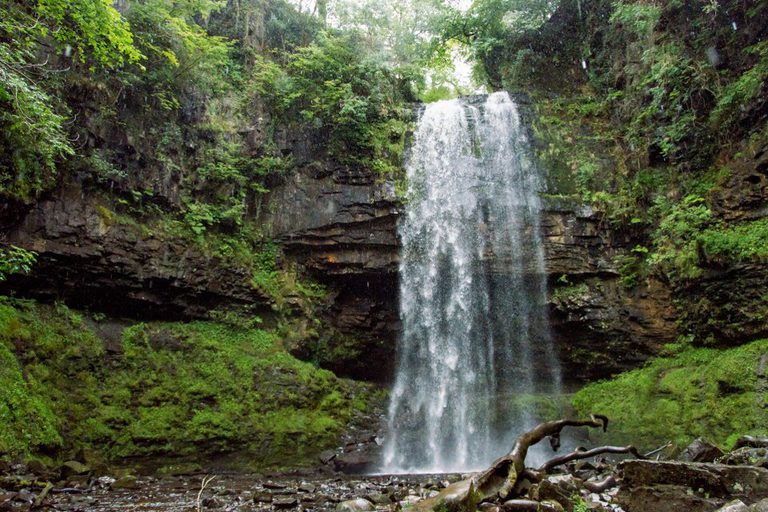
At 90 feet (27 metres), Henrhyd Falls is the tallest waterfall in South Wales, dropping into a wooded gorge near Coelbren. Batman fans may recognise the cave mouth behind the curtain of water from The Dark Knight Rises, and it's a fantastic experience to be able to walk behind the curtain!
This is only a short walk at around a mile there and back, but it is a steep flight of stairs almost immediately, and the surfaces are uneven and slippery throughout. No good for pushchairs or wheelchairs. If you want more, the Nant Llech circular from the same car park is 5.6km and two and a half hours, on a mix of made footpaths and rough woodland tracks, with steep drops to the side in places.
People do swim and paddle in the plunge pool at the bottom, and on a warm afternoon you will usually find somebody in it. If you join them, mind the depth: it varies across the pool and shelves away faster than it looks from the bank, and the water stays cold well into summer.
Parking at the National Trust car park is free, which is rare enough to mention. It is also small, and the Trust specifically asks people not to park on Dol Henrhyd, the residential street nearby.
The tip: go after heavy rain. The path will be filthy and the falls will be magnificent, and the Trust openly says wet weather is the best time to see them. Mind the spray on the rocks near the bottom, which makes the footing worse than it looks.
2. The Four Waterfalls Walk, Waterfall Country
The best waterfall walk in Wales, I love this trail and my kids too. Start from the Gwaun Hepste car park near Ystradfellte, wear good walking shoes (trainers are ok in the summer), and make sure you pack a good picnic with plenty of snacks! It's a circular trail of around 8km, which takes around three to four hours, or longer with kids.
The main loop is genuinely easy with wide paths, mostly stone-surfaced, gentle gradients and very few steps. But the four waterfalls are on spur paths off it, and those are "narrow, unsurfaced and slippery in places, with many steps", and rougher still next to the falls themselves.
The showpiece is Sgwd yr Eira, the waterfall of snow, where the path runs behind the falling water. Natural Resources Wales has levelled the worst of the rocks on that path and marked it better, but their own wording is worth repeating: "This is not a stroll in the park, it is a rugged walk in the great outdoors."
Parking at Gwaun Hepste is £6 a car, card only, but it gets busy so plan to arrive early if it's a nice weekend.

3. Pen y Fan and Corn Du
The one everybody does, and it is popular for a reason: at 886 metres Pen y Fan is the highest point in southern Britain, and on a clear day you can see Exmoor from it. The National Trust's circular route from Pont ar Daf is 6.4km, which takes in both Pen y Fan and Corn Du. It is officially graded moderate with steep steps near the summit, which is pretty accurate, although still fine for families who enjoy a hike. I've done it with and without kids, both enjoyable, and my kids were aged 8 when they first went up. The Trust gives three and a half hours on its web page, although it's more like two hours.
The paths are well made but sloped and uneven in some places. Generally the walk is fine in trainers, but walking shoes are better. The main path is well marked, but if you're exploring off the route make sure you have proper kit because the weather can change fast.
Parking at Pont ar Daf is £7.50 all day for cars, free for Blue Badge holders, motorbikes and National Trust members, and charges run twenty-four hours a day. Ignore any older advice about parking being scarce: the car park has been expanded by around 200 spaces, and there are now twenty-four hour toilets with a Changing Places facility.

4. Garwnant and Llwyn-onn Reservoir
The family one, this is great with younger kids as well as the answer when somebody in the group can't manage a mountain. Garwnant sits above Llwyn-onn Reservoir north of Merthyr Tydfil, and it is now run by Forest Holidays.
There is a walk here for every level with short waymarked loops around the visitor centre for pushchairs as well as small legs. If you want something longer, the Llwyn-onn Reservoir circuit is graded moderate by Merthyr Council, and is a touch over 4km, so around an hour to an hour and a half, on forest tracks and reservoir paths, with slight gradients and gates rather than anything steep.
The visitor centre opens 9am to 5pm daily, and 8.30am to 8pm on Mondays and Fridays, with the café running 8.30am to 5pm and doing pizza and cream teas. Parking is £2 for up to two hours or £5 all day on number plate recognition. There are accessible toilets with ramp access, a Changing Places facility, Blue Badge parking and wheelchair-accessible trails, plus a play area with a zip wire that will buy you twenty minutes of peace.
I wrote about a day out here in more detail in this article: autumn walk at Garwnant.

Walks near Cardiff
5. Castell Coch and Fforest Fawr
Twenty minutes from the centre of Cardiff lives a red Gothic fantasy castle with conical towers rising out of beech woods, and behind it several miles of free waymarked trails perfect for exploring with the kids.
The important distinction: the castle is Cadw and you pay, while the woods are Natural Resources Wales and you do not. NRW waymark four trails through Fforest Fawr, running from the Sculpture Discovery Trail at 2km long, through the Three Bears Cave Walk at 2.6km, to Sir Henry's Trail, a 4km circular linking both car parks in about two hours. Burges' Way, named for the architect who built the castle, is a 1.8km loop from the castle car park. Parking is free at both.
The beech woods are a Site of Special Scientific Interest in their own right, designated both for the ancient woodland flora underneath the trees and for the rock sequence the road cutting exposes, where Devonian sandstone gives way to Carboniferous limestone. They also form one of the three woods making up the Cardiff Beech Woods Special Area of Conservation, which Natural Resources Wales rates as one of the best areas in the United Kingdom for this type of beech forest.
If you do go into the castle, adult admission is £10.40 and a family ticket for two adults and up to three children is £33.30, with a five per cent saving for booking online. Those prices run to the end of March 2027. Winter opening is 10am to 4pm from November, stretching to 9.30am to 5pm in spring.

6. Bute Park, Cardiff
If you need flat ground and a surfaced path, Bute Park covers 130 acres from behind Cardiff Castle out along the Taff, and it is Grade 1 listed parkland restored with a £3.1 million Heritage Lottery grant.
The arboretum is well worth a visit, with over 3,000 individually catalogued trees, and the park says 41 of them are recognised as "champion trees", the tallest or broadest of their kind in the British Isles. They carry blue plaques on the trunks, and there is a trail that strings them together, plus a shorter family version covering fourteen.
Keep heading north and the Park runs into Pontcanna Fields, Llandaff Fields and Blackweir Woods without you ever leaving green space, which is often missed by visitors to Cardiff.
The park opens at 7.30am and the gates lock half an hour before sunset, which in December means 3.45pm, so pretty early. The times change every week of the year, so check the park's own locking table rather than trusting a fixed figure anywhere else, including ours. The Millennium and Fisher bridges stay open around the clock.
For parking, avoid Sophia Gardens unless you are only stopping briefly, because it charges around the clock and starts at £3.50 for the first hour. North Road and Pontcanna Fields are the better bet, and on a Sunday either will cost you £2.50 for over four hours.

7. Cosmeston Lakes Country Park
Two lakes, woodland, meadow and boardwalk in over 100 hectares just south of Penarth, and the easiest walk on this list to do with a buggy, a reluctant teenager or a dog. With paths snaking around the lakes and through the woodland there are routes of 2, 3.5 and 4 kilometres at Cosmeston, with routes displayed on a board at the visitor centre.
Terrain is genuinely easy: main paths, side paths and boardwalk, with kissing gates marked as wheelchair friendly, though there are stiles on some sections. Bikes are welcome except on the boardwalks, and dogs need to be on leads in the car park.
Parking is pay and display from 9am to 10pm, at £1 for an hour up to £5.20 all day, and free with no time limit for Blue Badge holders. You can pay by card or coins, or use the PayByPhone app.
There is a café with toilets and baby changing by the car park, and a snack/drinks van by the adventure playground.

Walks in the Wye Valley
8. Tintern Abbey and the Devil's Pulpit
Tintern Abbey is the enormous roofless ruin that launched a thousand Romantic poems, found in Monmouthshire on the Welsh bank of the River Wye. The best view is from the Devil's Pulpit, a rock ledge high on the English side of the valley where, according to the story, the devil stood and jeered at the monks working below.
Starting at the abbey the Devil's Pulpit route crosses the Wye on the Wireworks Bridge, built in 1876 as a rail link to the wireworks on the far bank, and the moment you are over the water you are in England. From the bridge the path climbs steeply through woods to meet Offa's Dyke Path along the top, and the ledge is a short way along it.
It's around a 8km circular walk with steep stretches in both directions, and the woodland paths get properly muddy from autumn onwards, so this one is walking boots rather than trainers.
Parking at the abbey is £5 in a car park of about 55 spaces with a 25-space overflow, card only, however the charge is refunded against any spend of £5 or more in the shop or cafe. If you would rather have the view without the climb, Forestry England's car park at Tidenham Chase on the B4228 above Chepstow is free and open all day, with Offa's Dyke signposted from it and the Pulpit reached on the level rather than up from the valley floor.

Walks on Gower and near Swansea
9. Three Cliffs Bay
I absolutely love being on the Gower, and Three Cliffs is one of my highlights - a river winding across the sand with three limestone points marching into the sea, and a ruined castle on the dune above.
You have a few options to walk, each with pros and cons, as you can approach the beach from different directions. From Southgate Car Park (National Trust) it's around a 1.6km in each direction, graded moderate, with steep climbs, a wooded valley section, muddy woodland floor and an uneven stony path. Parkmill is where I usually park, as there are three car parks and it's cheaper if you're not a NT member, but the walk is a touch longer at 2km. It's a good footpath, but gets sandier as you get closer to the beach.
I'd highly recommend taking a towel with you, and be prepared to take your socks & shoes off for a paddle! As the river winds across the beach, and the stepping stones can be under water depending on the tide, it can save you distance and time by cutting through the water.
Pennard Castle is a short detour above the bay, and the Wales Coast Path reckons the view from it is among the best in Britain.

10. Rhossili to Worm's Head
Three miles of beach below, and at the end of the headland a tidal island shaped like a sea serpent, which is what the Viking name means.
The crossing is possible for approximately two and a half hours either side of low tide, however Worm's Head is cut off completely at high tide, and people have died trying to swim back. The Coastwatch lookout on the headland keeps tide tables and the volunteers there will tell you whether to cross. You walk straight past it on the way out, so the sensible thing is to decide there rather than at the causeway.
You don't have to cross to make the trip worthwhile, as the National Trust's short circular from the car park out to the lookout is a mile, and graded easy, with gentle gradients and some steep stone steps on the way back. Their longer headland circular is 5.6km on unpaved and uneven ground that gets muddy, but has gorgeous views.
Rhossili parking is National Trust, £4 up to two hours and £8 over, charged around the clock, free for members, Blue Badge holders and motorbikes, although if you're doing the longer walk you'll need to budget for the £8. There are toilets between the car park and the shop, including accessible toilets and a Changing Places facility. For cheaper parking, Rhossili church has an honesty box, and charges £5 for the day.

What to take on a walk in South Wales
Layers and a waterproof, even in August. Weather on the top can change inside an hour, so check the forecast and be prepared.
A paper map for the mountain walks. Phone signal is patchy across the Beacons and non-existent in some of the gorges.
Cash and a card. For parking make sure you have both with you, whether it's these walks or others you'll find a variety of payment options whether by card, app, coins, or honesty box.
Tide times if you are going anywhere near Gower.
Ten walks, and we have barely started on the Valleys, the Heritage coast or the rest of the Gower. Pick one for the weekend, check the tide if it involves the sea, and take your walking boots.
Frequently asked questions
- What is the best walk in South Wales for a first-time visitor?
Pen y Fan, if the forecast is good - it's only four miles, the path is obvious, the views are the best in southern Britain, and it gives you the measure of the Beacons in half a day. If the weather is against you, Three Cliffs Bay on the Gower delivers more scenery per mile than anywhere else on this list.
- Which of these walks can you do with a pushchair or a wheelchair?
Bute Park is flat, surfaced and open from 7.30am. Garwnant has wheelchair-accessible trails, accessible toilets with ramp access, a Changing Places facility, accessible picnic tables and Blue Badge parking. Cosmeston's main paths and boardwalks are level, and its kissing gates are marked wheelchair friendly, though some routes have stiles.
- Do I need to book any of these walks?
No. All ten walks are open access and none require booking. The car parks are the constraint rather than the walks, particularly in Waterfall Country, where spaces are at a premium, so with good weather make sure you're heading out early.
- When is the best time of year to walk in South Wales?
September and October are the sweet spot: the paths have dried out from summer, the beech woods at Fforest Fawr and along the Wye turn properly, and the kids have gone back to school so fewer families on the roads. Winter is the best time for seeing the waterfalls, when there is most water coming over them, however it is also when the ground is worst.
Stay up to date
Sign up for the South Wales Guide newsletter to receive inspiration in your inbox for days & nights out, offers, competitions, trip planning ideas, and plenty more!
